
English :
Many years ago in Japan, before Zen Buddhism became widely known, students of the Tendai school practiced deep meditation to train their minds. Meditation was considered a powerful way to develop concentration, self-control, and inner peace.
Among the students were four close friends. They were sincere seekers who wanted to improve themselves and master the discipline of meditation. Although they were intelligent and dedicated, they often struggled with one common weakness the inability to remain completely silent.
One day, they decided to challenge themselves.
“We should test our discipline,” said one of them.
“Yes,” agreed another. “Let us observe seven full days of complete silence.”
The other two nodded enthusiastically. They believed that by remaining silent for seven days, they would strengthen their minds and deepen their meditation practice.
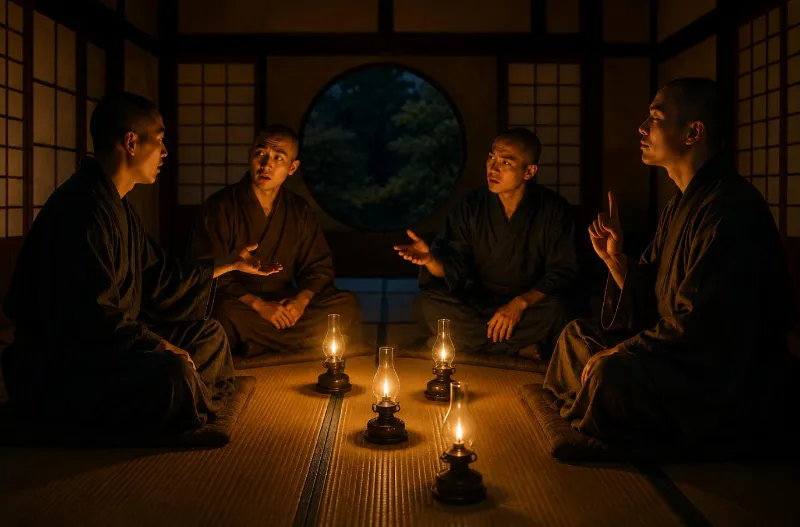
The next morning, they gathered in a quiet room in the monastery. Oil lamps softly illuminated the room. They sat cross legged, closed their eyes, and began meditating.
The first day went very well. No one spoke. Their minds became calm, and each of them felt proud of their determination.
As evening approached, darkness slowly filled the room. The oil lamps began to flicker and grow dim.
The first student noticed this and became distracted.
He tried to ignore it, but his concern grew stronger and stronger.
Finally, unable to control himself, he called out to a nearby servant:
“Please fix those lamps!”
The moment he spoke, he realized he had broken the vow of silence.
The second student opened his eyes in surprise.
“We are not supposed to say a word,” he said.
As soon as he spoke, he too understood that he had broken the silence.
The third student shook his head in frustration.
“You two are foolish. Why did you talk?” he exclaimed.
The instant the words left his mouth, he realized that he had also failed.
The fourth student looked at the others with a proud smile.
“At least I am the only one who has not spoken,” he declared triumphantly.
And with those words, he too broke the silence.
For a few moments, all four students sat quietly.
Then they began to laugh.
They understood an important truth.
Not only had they failed to remain silent, but each had also been eager to prove that he was better than the others.
Their desire to correct, criticize, and feel superior was stronger than their commitment to the discipline they had chosen.
That day, they learned that true silence is not merely the absence of words.
It is the quieting of the ego, the need to judge others, and the urge to prove oneself right.
Only when the mind becomes humble and still can genuine silence be achieved.
True silence is not just keeping your mouth closed; it is calming the ego, resisting the urge to correct others, and letting go of the need to prove that you are better. Wisdom begins when we learn to control both our words and our pride.
Source Credit: Google
Marathi :
जपानमध्ये झेन बौद्ध धर्म येण्यापूर्वी तेंडाई पंथातील विद्यार्थी ध्यानाचा अभ्यास करत असत. ध्यानाद्वारे मनावर नियंत्रण, एकाग्रता आणि अंतःशांती मिळते असे मानले जात असे.
अशाच चार जिवलग मित्रांनी ध्यानाचा सराव अधिक प्रभावी करण्यासाठी एक कठीण संकल्प केला.
त्यांपैकी एक म्हणाला, “आपण आपल्या मनाची खरी परीक्षा घेऊया.”
दुसरा म्हणाला, “चला, सात दिवस पूर्ण मौन पाळूया.”
इतर दोघांनीही उत्साहाने होकार दिला.
दुसऱ्या दिवशी सकाळी ते चौघे मठातील शांत खोलीत बसले. तेलाचे दिवे मंद प्रकाश देत होते. त्यांनी डोळे मिटले आणि ध्यान सुरू केले.
पहिला दिवस अतिशय चांगला गेला. कोणीही एक शब्द बोलले नाही. सर्वांना आपल्या शिस्तीचा अभिमान वाटत होता.
सायंकाळ झाली. खोलीत अंधार वाढू लागला. तेलाचे दिवे मंद झाले.
पहिल्या विद्यार्थ्याचे लक्ष त्याकडे गेले. तो स्वतःला रोखण्याचा प्रयत्न करत होता, पण शेवटी तो बोलून गेला:
“अरे, दिवे नीट कर!”
हे बोलताच त्याला जाणवले की त्याने मौन भंग केले.
दुसरा विद्यार्थी लगेच म्हणाला:
“आपण बोलायचे नाही असे ठरवले होते.”
हे बोलताच त्यालाही आपली चूक समजली.
तिसरा विद्यार्थी चिडून म्हणाला:
“तुम्ही दोघे मूर्ख आहात. बोललातच कशाला?”
आणि त्यानेही मौन मोडले.
चौथा विद्यार्थी अभिमानाने म्हणाला:
“मी एकटाच आहे ज्याने अजूनपर्यंत काही बोलले नाही.”
हे बोलताच त्याचेही मौन संपले.
क्षणभर चौघेही शांत बसले.
मग ते सर्व हसू लागले.
त्यांना समजले की ते केवळ बोलले म्हणून अपयशी ठरले नाहीत, तर प्रत्येकाला स्वतःला इतरांपेक्षा श्रेष्ठ सिद्ध करायचे होते.
त्यांचा अहंकार त्यांच्या मौनापेक्षा अधिक शक्तिशाली ठरला.
त्या दिवशी त्यांनी शिकले की खरे मौन म्हणजे फक्त शब्द न बोलणे नव्हे.
खरे मौन म्हणजे मन शांत करणे, इतरांना दोष देण्याची गरज सोडणे आणि स्वतःला श्रेष्ठ सिद्ध करण्याची इच्छा सोडणे.
खरे मौन म्हणजे फक्त तोंड बंद ठेवणे नव्हे; तर अहंकार शांत करणे, इतरांना दुरुस्त करण्याची घाई टाळणे आणि स्वतःला श्रेष्ठ सिद्ध करण्याची गरज सोडणे होय. जेव्हा आपण आपल्या शब्दांबरोबरच अभिमानावरही नियंत्रण ठेवतो, तेव्हाच खरी शहाणपणाची सुरुवात होते.
Source Credit: गूगल